 +92 300 859 4219 , +92 300 859 1434
  Cash On Delivery is Available
LEARNS is lengthy, and it takes a minute to digest 144 pages of proposed training coverage. We already knew probably the most egregious parts of the invoice, like implementation of a common voucher program by 2025, which could ruin our education system much like it did Arizona’s. And the invoice doesn’t tackle how any of those coverage packages will probably be funded, which is a crucial contingent when the state has to conjure up tens of millions of recent {dollars} to pay for youths in non-public faculty.
However we aren’t going to handle these massive questions on this publish. As an alternative, let’s dig into some particulars that reveal LEARNS is actually in regards to the cash — not in regards to the children.
Children can lose voucher accounts for low educational efficiency
The nationwide school-choice foyer has very efficient messaging: no child needs to be trapped in a failing faculty due to his or her zip code. Children and fogeys needs to be empowered to decide on colleges which might be greatest for them. Yada yada yada.
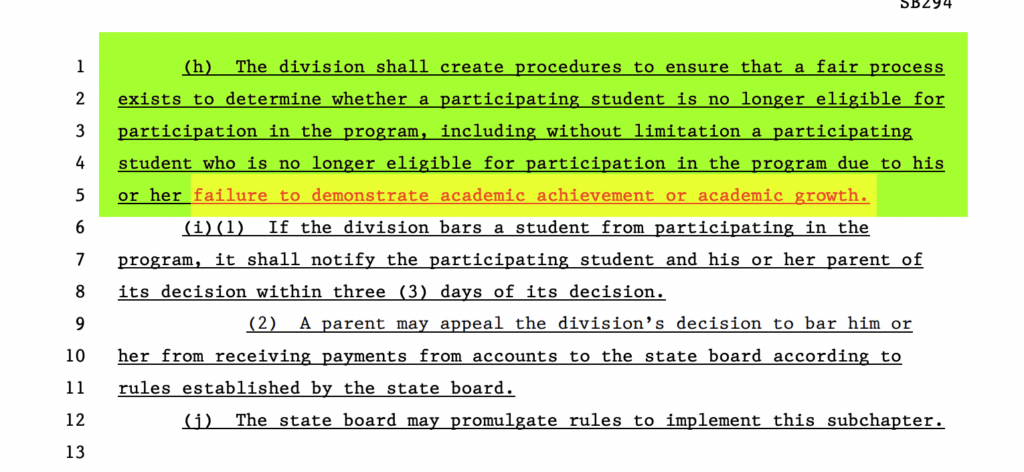
However web page 89 of the invoice states that youngsters who fail to fulfill educational requirements are ineligible to proceed with the voucher program. The invoice, nevertheless, doesn’t outline what these educational requirements are. If a baby applies to a personal faculty with a voucher however has a incapacity, behavioral problem or actually some other high quality {that a} non-public faculty determines is under their customary, that child will get booted. Non-public colleges aren’t required to just accept college students who apply with vouchers, and personal faculty aren’t required to proceed educating college students they deem unworthy. The underside line: solely sure children are entitled to vouchers.
Monetary establishments will generate income off tax-payer funded voucher accounts
When politicians say it’s not in regards to the cash, that often means it’s. We’ve mentioned how vouchers siphon public dollars from public schools. This system is ready up so taxpayers subsidize households’ non-public faculty tuition prices, which is fairly gross. However who else stands to realize from the voucher scheme? Banks.
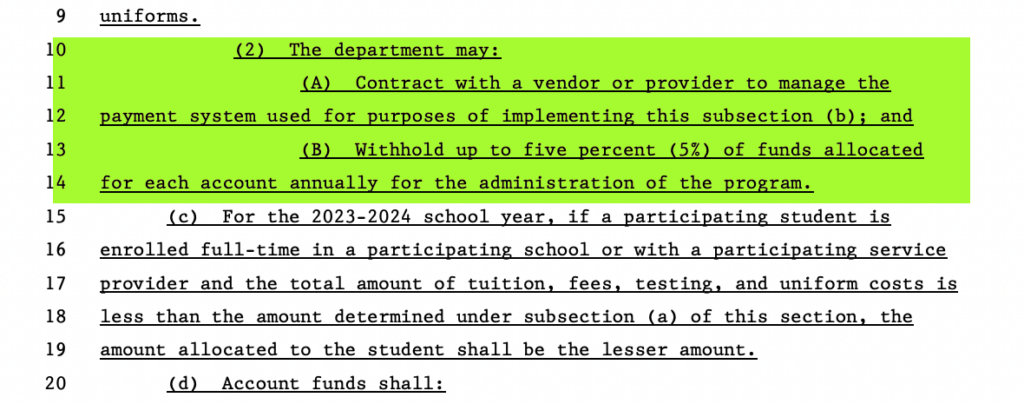
On web page 87, the invoice states that voucher-account service suppliers (i.e. monetary establishments) can withhold as much as 5% of the cash in each voucher account “for the administration of this system.” If each scholar presently enrolled in non-public faculty (~26,000 Arkansas college students) applies for a voucher account, that’s about $192 million in voucher accounts for one faculty yr. If account suppliers are skimming 5%, that’s $9.6 million a yr of taxpayer cash going on to banks and voucher account suppliers.
Public faculty lecturers to be paid by benefit, not expertise or training degree
LEARNS Act proponents need you to listen to that beginning lecturers will now make $50,000 a yr, up from the abysmal $36,000 new lecturers beforehand made. That’s nice, and one may assume such a beneficiant bump in beginning pay means all our lecturers get a major bump — however that’s not the case.
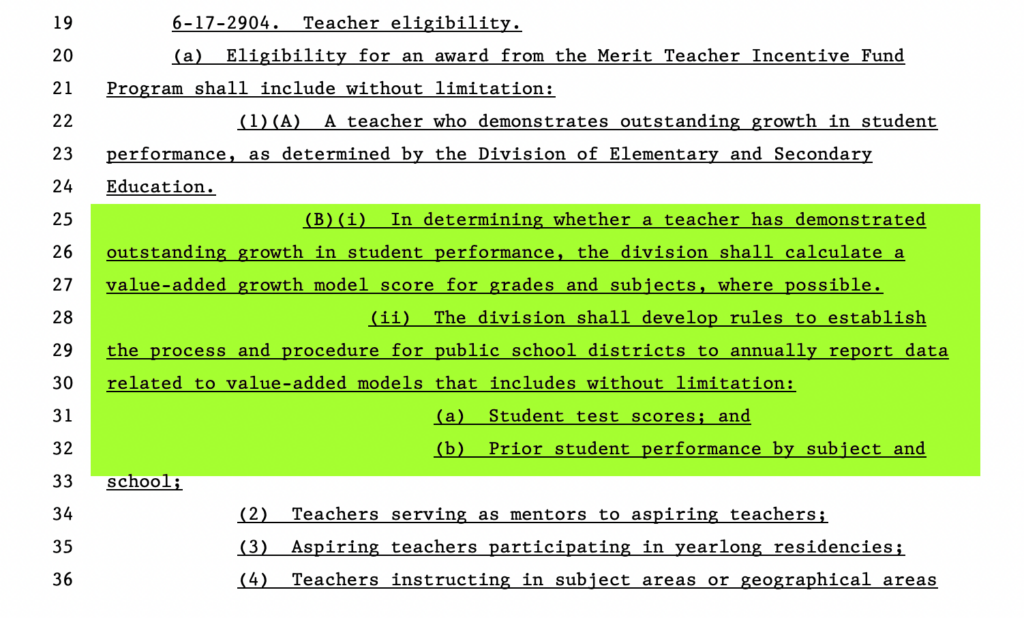
Academics incomes above the $50,000 threshold solely get a $2,000 pay enhance, which is far decrease than the Democrat-proposed RAISE Act enhance of $10,000 for all lecturers. Moreover, lecturers will now not obtain pay bumps primarily based on training ranges or expertise. Fairly, the invoice creates a merit-based pay program, which reward lecturers by way of a “values-added mannequin” (web page 77) that features standards like scholar check scores and scholar efficiency.
This is very unpopular with teachers. Faculties aren’t companies, and lecturers shouldn’t be handled like gross sales associates. A merit-pay mannequin additionally begs the query: How do lecturers who work with children with disabilities stand to fare? Pupil efficiency is tough to quantify; a merit-pay program received’t incentive tougher work as a result of our lecturers are already giving their all. Advantage pay will solely create an acrimonious atmosphere for our educators.
Arkansas can achieve this significantly better than the LEARNS Act. Whereas some parts are good, those that stand to profit most from the coverage aren’t our college students or lecturers. The true winners are those that will take our taxpayer cash and use it to counterpoint their already privileged lives.
The publish What we’ve learned about LEARNS appeared first on Arkansas Times.